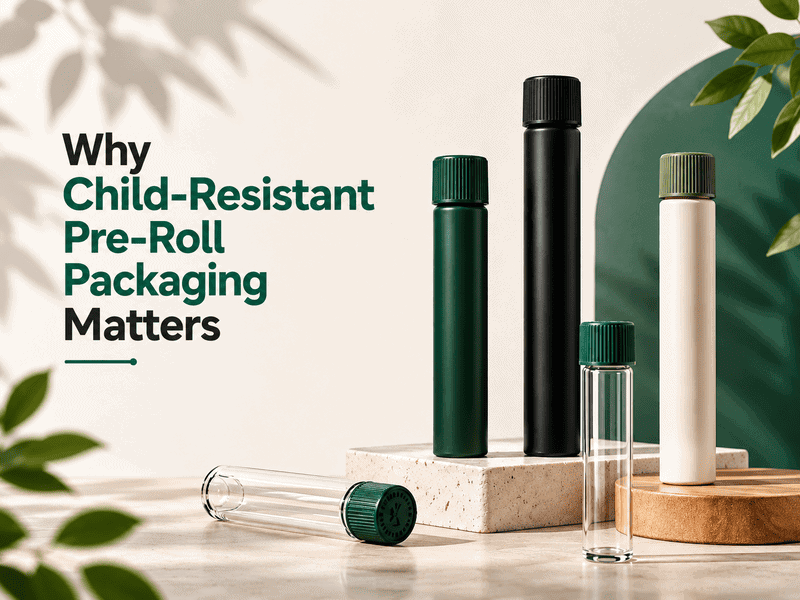
For any brand selling in a regulated U.S. market, child-resistant packaging isn't a feature to consider — it's a requirement to meet. Get it wrong and you can't legally sell your product. Get it right and you protect children, build customer trust, and keep your brand on the shelf.
This guide explains why child-resistant pre-roll packaging matters, what CR certification actually involves — including the exact test thresholds and the 2026 standards shift — and how to verify compliance before you order.
Why Child Resistance Matters
The core reason is simple: keeping potentially harmful products out of the hands of children. Cannabis products can be appealing and dangerous to kids, and child-resistant (CR) packaging is the safeguard regulators require to reduce accidental access.
But the impact goes beyond safety:
- Legal access to market — CR packaging is mandatory in regulated U.S. states; without it, you can't sell.
- Brand protection — a safety incident tied to inadequate packaging is a reputational and legal disaster.
- Customer trust — responsible packaging signals a responsible, professional brand.
In short, child resistance protects children first — and your business right alongside them.
What "Child-Resistant" Means — and What the Test Requires
Child-resistant does not mean childproof. In the U.S., it has a precise legal definition set by 16 CFR §1700.20, the testing protocol under the Poison Prevention Packaging Act (PPPA), overseen by the Consumer Product Safety Commission (CPSC).
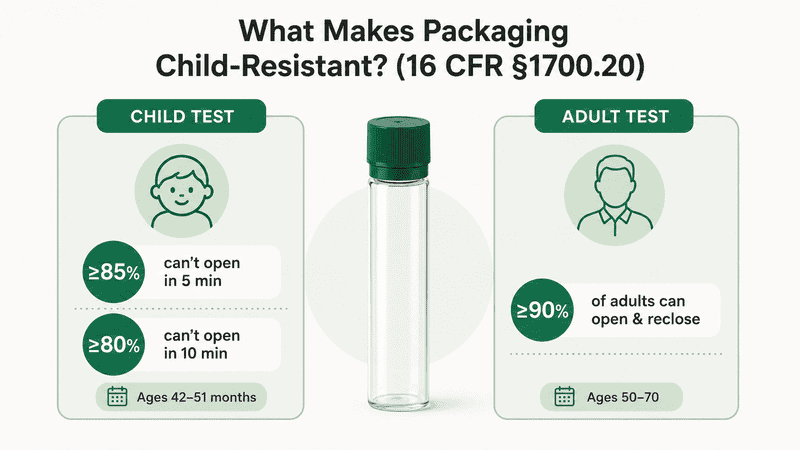
To qualify as child-resistant, a package must pass a protocol test using real panels of children and adults. The thresholds are specific:
| Test | Requirement to pass |
|---|---|
| Child test (ages 42–51 months) | At least 85% of children cannot open it within the first 5 minutes, and at least 80% cannot open it across the full 10-minute test. |
| Adult ("senior-friendly") test (ages 50–70) | At least 90% of adults can open the package and properly reclose it within the time allowed. |
In other words, the package must reliably defeat young children while staying accessible to older adults. That balance is the entire point — and it's why a tested, certified closure matters far more than one that merely looks secure.
Common Child-Resistant Closure Styles
Several CR mechanisms are used for pre-roll tubes. The most common — and the one we use on our pre-roll tubes — is:
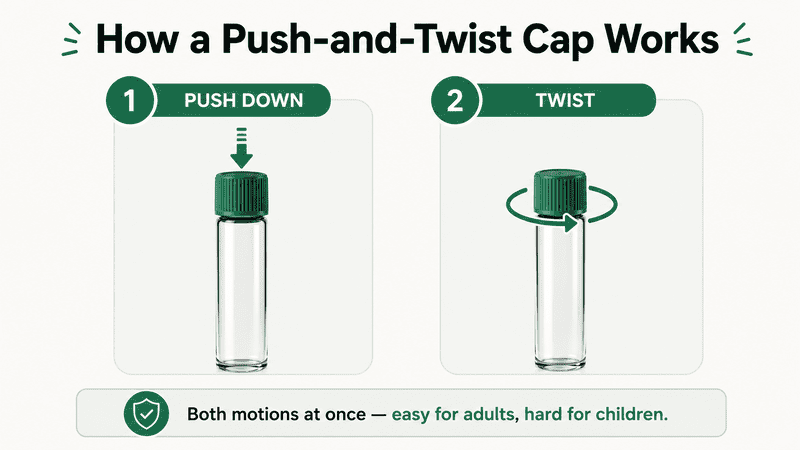
- Push-and-twist (push-down-and-turn) — the cap must be pushed down while turning, a coordinated motion young children struggle with. It's reliable, reseals fully after each opening, and creates an airtight, smell-proof seal at the same time.
- Squeeze-and-pull — the sides must be squeezed simultaneously to open, requiring coordination kids typically lack.
- Press-and-slide — a two-step motion combining pressure and movement.
For glass pre-roll tubes, the push-and-twist screw cap is the standard: it delivers child resistance, an airtight seal, and full resealing in a single mechanism.
How Compliance Affects Purchasing
For purchasing managers, compliance should be the first filter, not an afterthought. A non-compliant package — however attractive or inexpensive — is unusable in a regulated market. That makes CR certification a gatekeeping requirement before any other consideration.
When sourcing, build your decision in this order:
- Compliance first — CR-certified, meets your state's rules, with documentation.
- Function next — airtight, correctly sized, durable.
- Branding and aesthetics last — within the compliant, functional options.
Starting with compliance prevents the costly mistake of falling in love with a package you legally can't use.
State Requirements Are Shifting in 2026
Compliance isn't one-size-fits-all — and in 2026 it is actively changing. While CR packaging is broadly required across regulated states, the specific standard is evolving:
- Historically, most states followed the 16 CFR §1700.20 poison-prevention protocol.
- In 2026, several states — including New York, New Jersey, Minnesota, and Missouri — now require packaging to meet the updated ASTM D3475-2024 standard with full CPSC senior-friendly testing.
- Labeling, tamper-evident, and warning requirements also vary from state to state.
Always verify the current requirement for every state you sell in. A package compliant in one state — or under the older standard — may fall short under another. A knowledgeable supplier should help you navigate these differences and keep your documentation current.
Consumer Trust and Brand Responsibility
Compliance is also a branding opportunity. Customers increasingly notice — and value — responsible packaging. A reliable child-resistant closure tells customers your brand takes safety seriously, which builds the kind of trust that drives loyalty.
Many brands now highlight their CR and tamper-evident features on product pages and packaging, turning a compliance requirement into a trust signal. Done right, safety becomes part of your brand story rather than a box to check.
Packaging Features to Evaluate
When sourcing child-resistant pre-roll packaging, confirm:
- CR certification with test documentation (16 CFR §1700.20 and/or ASTM D3475-2024)
- Compliance with your specific state(s)
- A closure that is both child-resistant and airtight (push-and-twist)
- Tamper-evident options where required
- Recognized factory certifications (ISO, BSCI, CE, RoHS, MSDS, CFR, EMC)
- Consistent quality across the production run
Material and process quality matter too. Our pre-roll tubes use food-grade borosilicate glass — durable, chemically inert, and resistant to thermal shock — and are produced under ISO, BSCI, CE, RoHS, MSDS, CFR, and EMC standards. If a supplier can't provide certification documentation, treat that as a dealbreaker, not a detail to sort out later.
Frequently Asked Questions
Is child-resistant packaging required for pre-rolls?
Yes. In regulated U.S. markets, child-resistant packaging is legally required to sell cannabis pre-rolls. Selling without it risks penalties and removal from the market.
What does the child-resistant test actually require?
Under 16 CFR §1700.20, at least 85% of tested children (ages 42–51 months) must be unable to open the package in the first 5 minutes and at least 80% across the full 10 minutes, while at least 90% of adults (ages 50–70) must be able to open and properly reclose it.
What's the difference between child-resistant and childproof?
Child-resistant means tested to be significantly difficult for young children to open while remaining accessible to adults. "Childproof" implies impossibility, which no packaging guarantees — the regulatory standard is child-resistant.
What is ASTM D3475, and how is it different from 16 CFR 1700.20?
ASTM D3475 is a classification standard for child-resistant packaging. In 2026, several states have moved to require the updated ASTM D3475-2024 standard with full CPSC senior-friendly testing, in place of relying on the older 16 CFR §1700.20 protocol alone. Requirements vary by state, so confirm what applies to your market.
Can a tube be both child-resistant and airtight?
Yes. A push-and-twist CR screw cap delivers child resistance and an airtight, smell-proof seal at the same time — and reseals fully after each opening.
How do I verify packaging is truly CR-certified?
Ask the supplier for test documentation showing the closure passed protocol testing. Note that the CPSC does not certify packaging or manufacturers, so verification and compliance are the brand's responsibility — documentation is your proof.
Source Compliant Pre-Roll Packaging With Confidence
Anjoyme Packaging is a custom cannabis packaging manufacturer specializing in CR-certified, state-compliant pre-roll tubes — push-and-twist caps, food-grade borosilicate glass, and ISO / CE / RoHS-certified production, backed by 20 years of OEM/ODM experience.
Request CR Packaging & Documentation → Or browse our full packaging range →This article is for general informational purposes only and is not legal advice. Child-resistant packaging regulations vary by state and are changing in 2026 — always confirm the current requirements for your market with the relevant authorities or qualified counsel, and request test documentation for your specific packaging.